Crinoid fields TA
This project (2022) was rendered using Unreal 5.1 and even with Lumen and Nanite I had to keep the GPU memory in check because it was rendered with a RTX 2070 Super (only 8gb of vram and we filled it!). Almost all texturing is done with Substance Designer and is using kind of the same setup for every asset. The crinoids are all skeletal meshes and almost everything else is static meshes. I created the planet part with 3Ds Max & Vray that's why it's not in the breakdown. We created this animation with Pascal Ceotta in around 3 months. It was created for the "Centre d'interprétation de la pierre" of Sprimont.
A crinoid field 350 million years ago in Sprimont Belgium. You can see some brachiopods, polyps, syringoporas, trigonias, gasteropods and a Holocephali fish.

Since we had a lot of species to create with some that don't appear in the video we had a lot of resources gathered by specialist. There was a part of freedom to create species that didn't exist and it had to be correct for specialists.
I received a scanned model (for almost all species) that was simplified with the retopology tool in 3DS. In Substance Designerr I generated textures from high to low poly to texture it procedurally and pack it. There is a blend in the shader for the terra
Some parts of the Brachiopod are translucent, I created a frosted shader to give the illusion.
Procedural modeling with Railclone and a few modifiers. You can see and old version of the stem. I use vertex alpha color to store a gradient for shading with UV on the feathers.

Beauty shot of a Crinoid with Vray for print.

Material & lighting Setup in 3DS. There is a mix of procedural shading by using noises and vertex color datas.
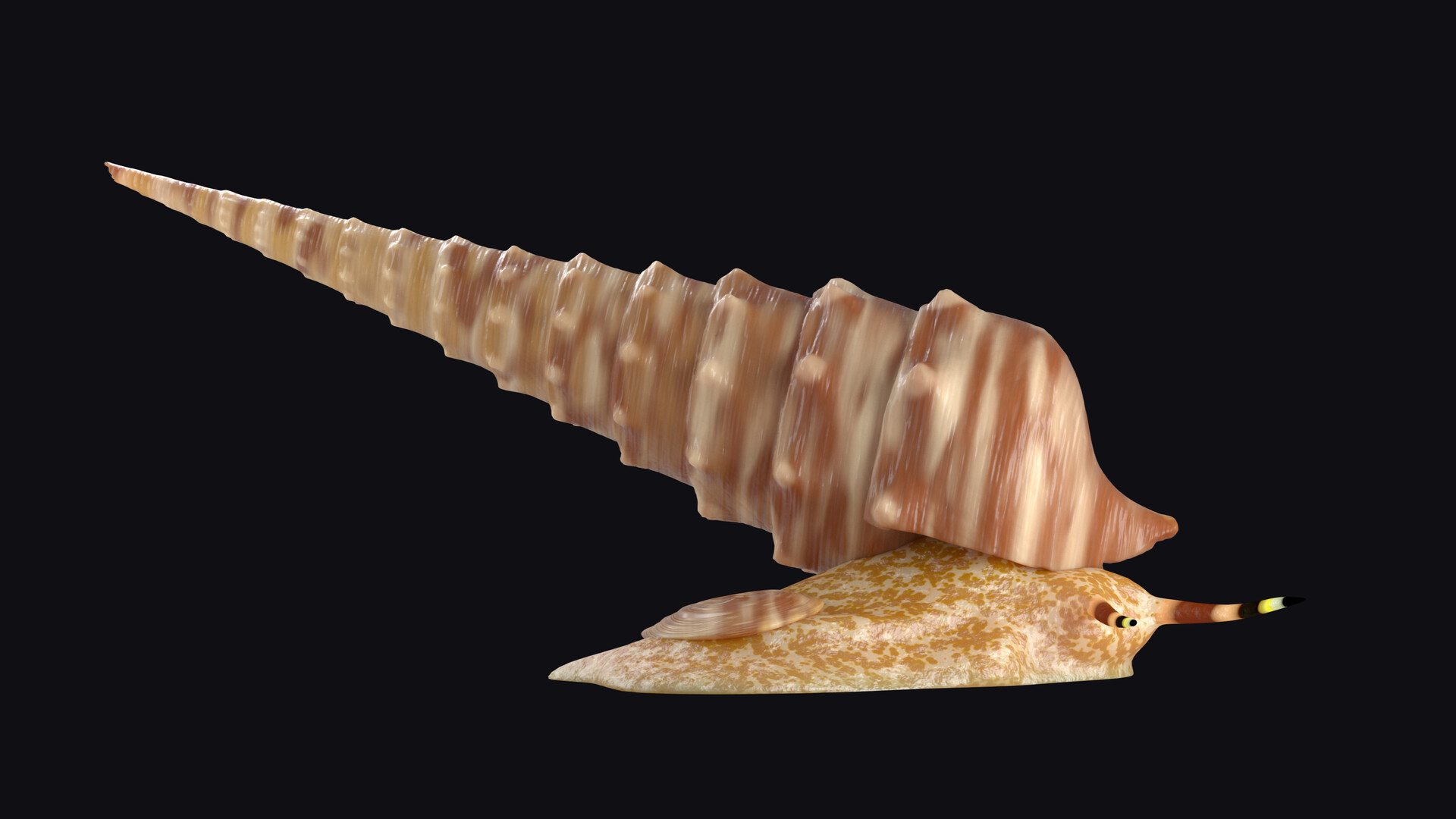
This Gasteropod is not present in the video but it was fun to make. Also with Vray for print. The shell comes from a scanned model.
This is the render setup. Only the first image is created to texture it, there rest is only a mix of noises, curvature topology information and vertex color gradient from custom selections.
The landscape/terrain setup is pretty simple since the sediment will cover it. Almost all other assets blends with the landscape texture (that's why it appears pink in some preview).
Multiple sediments models were generated with tyFlow and randomized by material id.
To assemble the polyps on the Michelinia I baked their animation to a texture that I can reuse in Unreal. Tyflow was used to spawn triangles (some were edited manually) that serve as a base for position and orientation of polyps then spawned with Niagara.
I had a setup to model the Syringopora using tyFlow but it is broken maybe due to newer graphics driver since the rest is the same (every save file fail the same way). You will have to trust me :). The polyps were spawned as with the Michelinia.
Lighting made of a sun, fog skylight, with a spotlight for caustics. A little bit of postprocess but composition was done with Davinci Resolve. I ended up creating a blueprint to test some variables in real time without rendering.
Quick scene overview. The render is different because I migrated to Unreal 5.2 for the breakdown and didn't try to get same render. Assets were painted or placed manually with the camera in mind.